A First Look at SOAS Library Manuscripts
June 16, 2026, 7:33 PM
Since yesterday, I've been staying at the home of my old friend Dr. Arthur Dudney in London. Arthur was a Masters student in Middle Eastern, South Asian, and African Studies at Columbia University when I was doing my PhD there. He is now working for the Arcadia Fund, a philanthropic organisation that, among other things, funds the amazing Endangered Archives Program at the British Library. Arthur is also the author of India in the Persian World of Letters: Ḳhān-i Ārzū among the Eighteenth-Century Philologists (Oxford University Press, 2022).
It happens that I have never before visited the Library of the School of Oriental and African Studies, which I therefore prioritized today. In the past, the British Library's openness to scholarly research, and especially the taking of free photographic copies, made repeated visits to the BL a sine qua non for South Asianist scholars, whereas the SOAS Library was understood to be guarded by dragons. These days, however, the reputations are exactly the reverse. It's Pride month. Therefore I received my SOAS Library reader card with a suitably ranbo lanyard, convenient for garlanding myself with and slapping onto various entrance/exit readers into the building and the library itself.
Manuscripts
I have two main targets. I'm curious about SOAS' manuscript collection, the descriptions of which I've browsed on Fihrist already. Currently, MSS can be ordered through the special Archive Catalogue. Staff perform two retrievals per day, at 11am and 2pm, with 3 items pre-orderable, and an additional 3 items orderable per daily slot (6 extra items per day) during the actual visit, for a total of 9 items. I suppose that this system ensures that staff don't go to the trouble of retrieving lots of fragile materials for readers who order online from home but never bother to show up in person.
At the time of writing, Fihrist has descriptions of 1025 MSS, half of which are in Persian, of course.
I am also keen to access SOAS' regular collection of circulating items.
Afarin's Hir
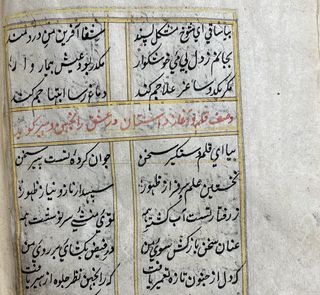
Today I was chiefly interested in seeing MS 18820, a volume of four qissahs including Āfarīn Lāhaurī's Qissah-i Hīr o Rānjhan, an 18th-century Persian masnawī version of the Punjabi love story of Hir and Ranjha. Though this book is available in print, it is always instructive to see such texts in manuscript form. Other texts in the volume, ‘Attār's Be-sar-nāmah and a Qissah-i Khwājah Ja‘far, contain colophons indicating that they were completed on the 17th of Rabi‘ al-Awwal 1237 (December 12, 1821) and the 9th of Jumadi al-Awwal 1237 (February 1, 1822) respectively, so that this copy of Āfarīn's Hīr was likely made in 1821/1822 CE. Though the MS is not in great shape, the nasta‘liq is clear, and it must have been a nice copy in its time.
Bagh o bahar
I had ordered two versions of the ubiquitous Qissah-i Chahār darwesh (Tale of the Four Dervishes). My Masters student Sheheryar Ahmed is writing about Mīr Amman's Fort William Urdu translation, Bāgh o bahār, and I've written a paper on it myself that I should probably publish some time. MS 1507 was a copy presented to the SOAS Library by SOAS' Sanskritist Prof. Lionel David Barnett (1871-1960). I have some recollection of reading an essay or two by Barnett on Hindi-Urdu subjects as well. On one of the opening pages a former owner has inscribed "pihlā [sic] jild … yih kitāb chahār darwesh kī sair meñ uwilyam kyāniñg kī thī." That is, with thanks to Zahra Sabri for helping me decipher the bizarre name, "First [incorrectly muzakkar] volume … This book of the travels of the four dervishes belonged to William Canning."
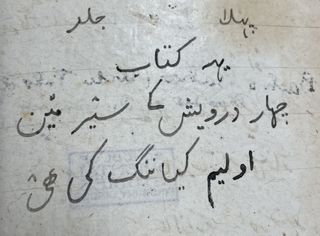
The other version is ordered for June 19th.
Mazhab-i ‘ishq
SOAS MS 48850 is a copy of Nihāl Chand Lāhaurī's Urdu Mazhab-i ‘ishq, a translation of the Persian Qissah-i Gul-i Bakāwalī. Nihāl Chand's version was written in 1802 at Fort William College. This copy has no jadwals and is in quite cursive nasta‘liq, though not quite shikastah-amez. A handwritten insert provides the following description in English (square brackets in the original):
Madhhab-i ‘Ishq { This is the title of the work and its chronogram
An Urdu version, by Nihāl Cand Lāhaurī, of Gul-i Bakāvalī. The chronogram at the close gives the date of composition as 1217 H/1802 A.D. [as in Grahame Bailey's *History of Urdu Lit., p. 82].
The writer states in the beginning that he came to Calcutta in attendance on Capt. David Robertson, through whom he was there introduced to Dr John Gilchrist, at whose instance he was asked to translate the story/romance of Tāju'l-Mulūk and Bakāvalī from Persian into the idiom of Hindi Rekhta. He translated it into "Hindi" [Urdu prose] and called it Madhhab-i ‘Ishq.
The romance was versified by Nasīm (G.B.'s Hist. of U. Lit., p. 62).
This work has been lithographed, once at least in Calcutta (1265/1849 A.D.), but probably several times.
This is almost certainly not the author's copy; paper like it I have found in use c. 1830.
Mazhab-i ‘ishq is usually found purposely bowdlerized. If it is worthwhile I might write an essay about this practice, from Pandit Dattatreya Kaifi's version marking the qissah as "Children's Lit." to Khalil ur-Rahman Daudi's unfortunately self-censored edition (who censors an edition?!). This manuscript copy seems to be curtailed in general, so that the omissions may or may not be purposeful elisions of perceived obscenity.
Circulating Books
The circulating books I want are mainly 20th-century printed books in Punjabi or about Punjabi literature. These are apparently stored offsite and are available for what is called "long loan." I assume that this means that I could take them out of the Library, but as it happens, I read them on site.
I won't go into all of the long-loan books I've seen at SOAS. I'll just briefly note that I took a look at Mohan Singh Uberoi's 1930 edition Bulhe Shāh: 50 kāfīāñ, published by the University of the Punjab Press, Lahore. This was the main text I wanted to see. I will need a bit more time to peruse it properly, but already I see that is useful as a snapshot from 1930 of the state of textual criticism of the poetry of Bullhe Shah, on whom I have a draft paper ready, and in whose work my incoming PhD student Khyam Arain is interested.
It isn't clear whether she had access to this specific copy, but at the beginning of the 1930s, Lajwanti Rama Krishna was ostensibly working on her doctoral dissertation at the University of London, which was completed in 1934; a work that was published in 1938 as Panjabi Sufi Poets A.D. 1460-1900 (Oxford University Press). I say "ostensibly" because I haven't seen her U. of L. diss., and her French PhD diss. was published in 1932 as Les Sikhs: Origine et développement de la communauté jusqu’à nos jours (1469–1930) (Paris: Maisonneuve). As Christopher Shackle writes in his critique of her influence, Dr. Rama Krishna was a "person of considerable determination" (Shackle. 'Punjabi Sufi Poetry from Farid to Farid' in Punjab Reconsidered: History, Culture, and Practice Ed. Anshu Malhotra and Farina Mir. Oxford University Press, 2012, fn. 1). Possibly she was capable of bilocation like certain Mughal-era Sufis. In any case, I don't see any citation of Uberoi in Rama Krishna's book.